Refuge at Sea Life Park—The Amazing Story of Niblet and Brawler
By Kent Coules, Publisher
Sea Life Park in Waimanalo has a long history of rehabilitating animals, but the rescue of two California sea lions, Niblet and Brawler, tested the expertise of marine mammal professionals from the West Coast to Hawai‘i.
“We had to work with multiple agencies to get Niblet and Brawler here safely,” says Sea Life Park Curator Jeff Pawloski. “The regulations and logistics we had to negotiate were tough, but Niblet and Brawler arrived here safely on January 9.”
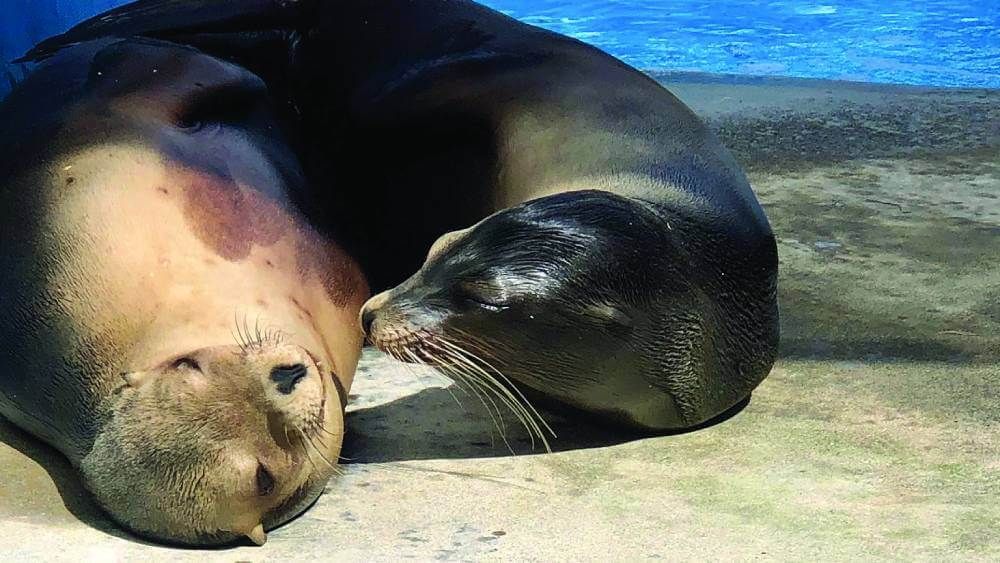
In 2017, the two female sea lions were rescued separately a few months apart by Pacific Marine Mammal Center (PMMC), and quickly bonded together during the course of their recovery and rehabilitation process. Niblet was found suffering from extreme malnutrition, while Brawler had a severe infection of the cornea in both eyes.
After their respective rescues and treatments, both Niblet and Brawler were subsequently returned to the wild in separate releases—only to have each one need to be rescued again by the non-profit. Deemed unreleasable by the National Marine Fisheries Service, a division of National Oceanic and Atmospheric Administration (NOAA), the sea lions continued to be cared for by PMMC. However, with the facility designed for short-term needs, PMMC placed a call out to partner facilities qualified to care for pinnipeds. Especially suited to assist, Sea Life Park stepped in to provide a home in Hawai‘i for both sea lions.
“ Sea Life Park is on a list to accept stranded, non-releasable animals with the National Marine Fisheries Service,” says Pawloski, “but being cleared to be Niblet and Brawler’s permanent home was just the beginning.
“Due to Hawai‘i laws, we had to run through the Department of Agriculture’s strict 30-day quarantine and blood-testing protocol. Then we had to come up with a transport plan.
“We needed to find a California veterinarian to accompany Niblet and Brawler on the trip. We also had to work with FedEx to identify the best and fastest routes and work through so many details—everything from the temperature on the tarmac to cage requirements.
“Wild animals are never domesticated and can get overexcited to the point of death. The vet was with the sea lions for the entire trip, and had necessary medicine to make sure the animals stayed calm.”
The sea lions, who are inseparable and came as a pair, arrived safely and in good health. “That is no small feat considering their history.”
Niblet was first rescued by the PMMC January 4, 2017 in Huntington Beach, California. She was found malnourished, dehydrated and weighed only 19 pounds. After much care she was microchipped and released, but was found again in January of 2018. She had lost 20 pounds from her first rehabilitation. She was deemed unreleasable after being unable to catch her own food in her second rehabilitation.
Brawler was first rescued by the PMMC on May 7, 2017 in Dana Point, California. She had a slight grayish coloration in both eyes, and after much care, was released on September 14 that same year. Four days later, she was found again, nearly lifeless. Her eyes were white and glossed over, and it was determined that she was 70 percent blind. She was also deemed unreleasable.
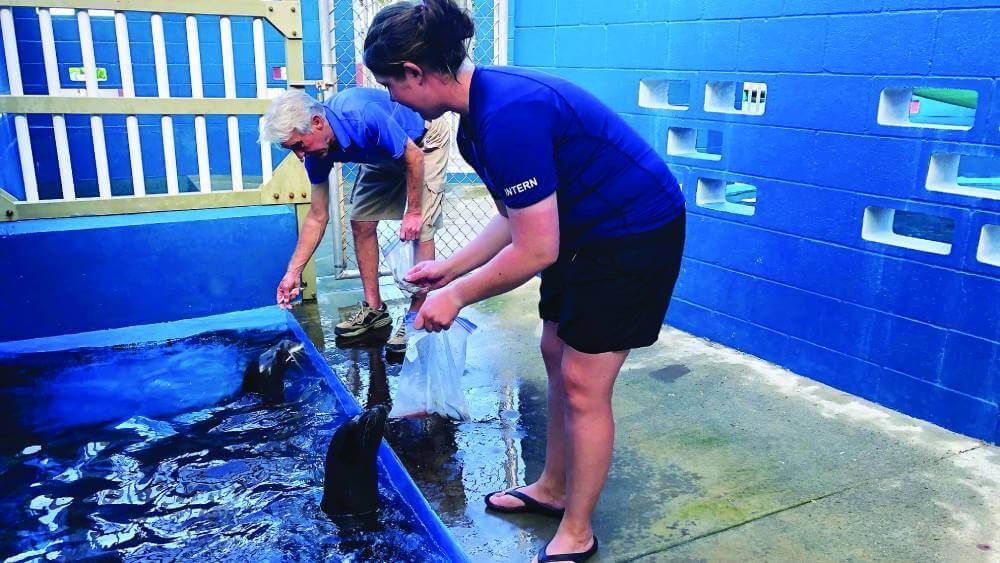
“If not for the amazing volunteers at PMMC, Niblet and Brawler would not have survived,” says Pawloski. “We consider it a great honor to be ‘foster parents’ and continue the wonderful work provided by PMMC.”
The two were paired after their second rescue and they quickly bonded. “I heard that Brawler was the alpha, but now Niblet shoots out of the water when we enter the quarantine area and up to the gate,” says Pawloski. “I didn’t expect Niblet to be as independent. Niblet tends to eat more, and will even eat the scraps Brawler leaves, and Brawler lets her.”
Now released from quarantine, Niblet and Brawler’s new home is the Nursing Pool just outside the Sea Lion Exhibit. “Everything is done carefully regarding diet, social introduction and stimulus control. We’re in the process of bumping their diet now. So far everything has gone incredibly smooth.”
Pawloski adds that the new Sea Lion Exhibit will be the most natural habitat in existence at the park. “It will feature sculptured rock work, algae, crustaceans and fish. It won’t look as ‘sparkling’ as what one might be accustomed to at a marine park, but it will be healthier and more stimulating for the animals.”
For more information on Niblet, Brawler and Sea Life Park, go to sealifeparkhawaii.com.
[A version of this article appears in print in the pages of This Week O‘ahu]