Kaua‘i’s Humpback Whales
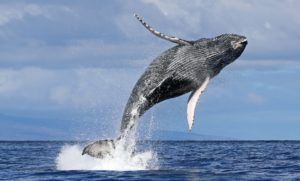
Koholã—the Hawaiian word for Humpback whales—are seen regularly around Kaua‘i and Ni‘ihau from December through April, although occasional sightings occur as early as mid-October through early June. If you’re lucky, you’ll get to witness incredible acrobatic displays by these gentle giants who migrate over 3,000 miles to visit Kaua‘i’s warm waters to breed, calve and nurse their young. Humpback whales are inquisitive and will often approach boats, giving us a spectacular demonstration of some of their common behavior including breaching, blows, head rises, and tail slaps.
A member of the baleen whale suborder, the Humpback whale (Megaptera novaeangliae) is large, even among whales with adults reaching between 12–16 meters (40–50 feet) long and weighing approximately 40,000 kilograms (44 tons). It is a favorite among whale watchers for its impressive size, acrobatic and spectacular breaching behavior (sometimes leaping completely out of the water), large fluke and unusually long pectoral (front) fins which are proportionally the longest fins of any cetacean.
Identification
Humpback whales are identified by their stocky bodies with obvious humps and black dorsal coloring. The long black and white tail fluke has a wavy trailing edge and can be up to a third of body length. The pectoral fins have unique patterns, which enable individual whales to be recognized. When exhaling through their blowholes, Humpbacks have a distinctive 3 meter (10 ft) heart-shaped to bushy blow.
Feeding
The species feeds only in summer and lives off fat reserves during winter. It is an energetic feeder, taking krill and small schooling fish, such as herring, capelin and sand lance. It will hunt fish by direct attack or by stunning them by hitting the water with its large flippers or flukes.
Its most inventive feeding technique is called bubble net fishing. A group of whales will blow bubbles while swimming to create a visual barrier against fish, while one or more whales in the group make vocalizations that drive the fish against the wall. The bubble wall is then closed, encircling the fish and confining them to an ever-tighter area. The whales then suddenly swim upwards and through the bubble net, mouths agape, swallowing thousands of fish in one gulp. This technique can involve a ring of bubbles up to 30 meters (100 feet) in diameter and the cooperation of a dozen animals at once. It is perhaps the most spectacular act of cooperation among marine mammals.
Like other large whales, the humpback was and is a target for the whaling industry. Due to over-hunting, its population fell by an estimated 90% before a whaling moratorium was introduced in 1966. Once hunted to the brink of extinction the humpback whale population has since partially recovered with at least 80,000 humpback whales worldwide. Entanglement in fishing gear, collisions with ships, and noise pollution remain concerns.
[Content provided by Holo Holo Charters. A version of this article appears on their website.]